Tenth Triage · How it works
One case in. One verdict out.
Each case is judged once, checked again, and then either closed with the reason recorded or put in front of a person.
The steps
From alert to decision.
- 1. Alerts arriveFrom Tenth Signal, or from the SIEM you already run through an API key you create and own.
- 2. Grouped into a caseRelated alerts become one case.
- 3. Judged and explainedResolve, Escalate, or Unsure, so escalate. Each with short reasoning and the client rules it used.
- 4. Checked againA Resolve is asked again, and any disagreement escalates. Then the pre-close checks run: whether another case on the same workstation was escalated in the last 24 hours, and whether attack stages are building across cases (3 or more cases covering 4 or more attack stages within 72 hours). If either is true, it holds the close and passes the case to a person. Any doubt and it escalates.
- 5. Closed or handed upA checked Resolve on a case at a severity you choose is closed with the reason recorded. Cases at a severity you leave off go to your analysts. A fixed list of 39 named malware and attack-tool families is always escalated, never closed.
- 6. RecordedVerdict, reasoning and escalation timeline stay on the case and in reports.
How triage works
One case in. One verdict out.
Automated Review returns Resolve, Escalate, or Unsure, so escalate. Each with short reasoning and the rules it used.
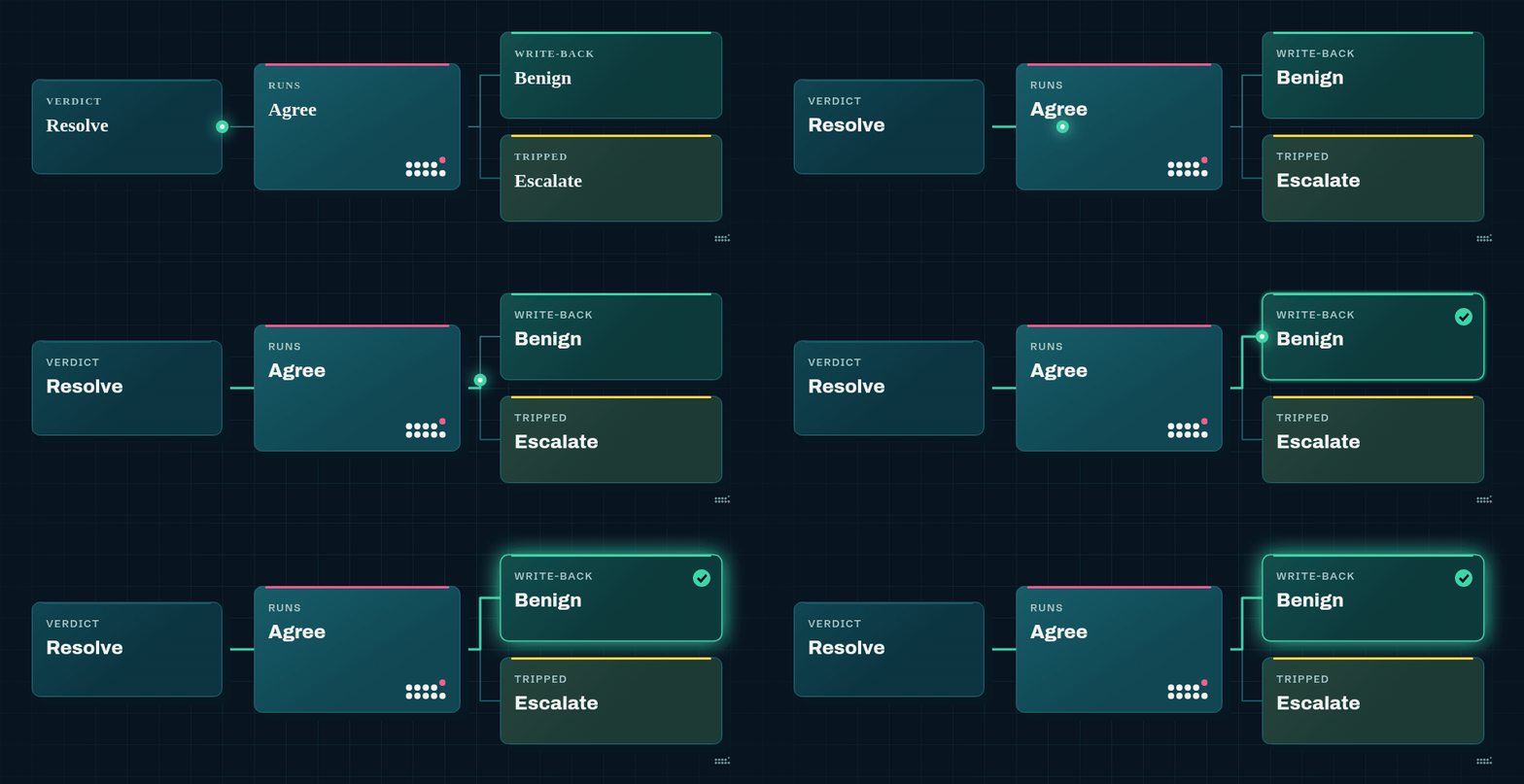
Sample data · illustrative · motion pauses when reduced-motion is on
- ResolveChecked again with repeat runs, then pre-close checks. A clear Resolve is recorded as routine, with its reasons.
- EscalateStarts the escalation path: contacts in order, email, voice or both.
- Unsure, so escalateTreated like Escalate. There is no review queue to get lost in.
Doubt always escalates. If your team already acted, it stands down. Severity never changes.
Outcomes
Analyst hours back. Escalations that land. Proof on record.
- Analyst hours backRoutine cases are sorted with a reason on record, so your team spends time on cases that need them.
- Escalations that landContacts are tried in order, by email, voice or both, with every attempt recorded.
- Proof on recordWho was contacted, what was closed, and why. On the case and in reports.
Learned rules
It suggests rules. You say yes or no.
Tenth Triage suggests rules that escalate or close cases. A closing rule is tested for 30 days on live cases, and needs a person to say yes. A new setup starts watch-only.
What it does
What it handles, and what needs a person.
On its own
- Collects alerts and groups them into cases.
- Judges each case and explains it.
- You choose which severities it handles.
- Flags when the same kind of case was escalated before.
- Suggests rules and tests them on real cases before anyone is asked to approve.
- Chases overdue cases and hands them up when nobody answers.
- Produces the reports.
Needs a person
- Every case at a severity you leave off, including Critical and High if you switch them off.
- Containing a threat: a person presses the button, or turns on and approves automatic containment.
- Yes or no on rules.
- Talking to the client.
The record
Every decision is on the record.
An append-only audit log keeps the verdict, the reasoning and the rules used or set aside. Accuracy is scored by people: how often a decision matched what a person later set.
Next step
Try the demo, or talk to us.
The demo uses sample data.